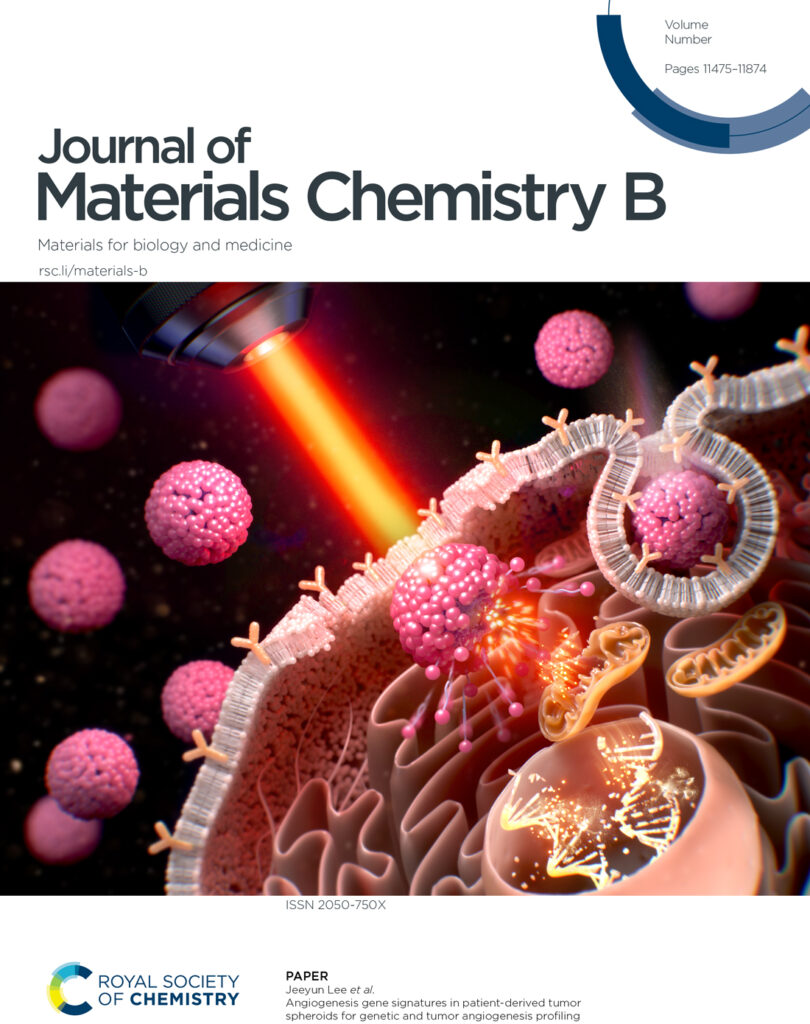
Journal cover / Journal of Materials Chemistry B 28 November 2025, Issue 44,
https://pubs.rsc.org/en/journals/journalissues/tb#!issueid=tb013044&type=current&issnprint=2050-750x
Lactose-functionalized photosensitizer nanoparticles derived from thiophene-fused BODIPY for NIR-imaging-guided photodynamic treatment of hepatocellular carcinoma
Four near-infrared (NIR) photosensitizers (PSs) (PHTB, PBrTB, THTB, and TBrTB) based on thiophene-fused, BODIPY-conjugated, and liver-tumor-targeting lactose were synthesized and characterized. Brominating the BODIPY core of PHTB and the terminal thiophene rings of THTB yielded PBrTB and TBrTB, respectively. All derivatives exhibited strong NIR absorption (λab = 640–674 nm) as well as moderate fluorescence quantum yields (ΦF = 0.21–0.35) and self-assembled into stable, uniform nanoparticles (∼30 nm) in aqueous solution, driven by the hydrophobic interactions of the BODIPY core and hydrophilic lactose moieties. PBrTB produced the highest singlet oxygen quantum yield (ΦΔ = 0.47) with potent light-induced cytotoxicity, with IC50 values of 75.8 nM and 66.4 nM for Huh-7 and Hep3B cells, respectively. The IC50 values of the other thiophene-fused BODIPY NPs exceeded 250 nM. PHTB displayed moderate theragnostic potential owing to the high fluorescence and cellular uptake; however, PHTB generated less singlet oxygen and exhibited lower PDT efficacy than PBrTB. The intracellular uptake and reactive oxygen species generation of the PHTB and PBrTB nanoparticles were substantially higher than those of THTB and TBrTB, likely because of the ASGP-receptor-mediated delivery via lactose. These findings highlight PBrTB as a simple and effective single-component theragnostic agent for NIR-imaging-guided photodynamic treatment for hepatocellular carcinoma.